

In the Solarpunk vision, cities hum instead of roar, air is breathable, and transport syncs with renewable energy. At the center of that future stands the electric vehicle (EV)—quiet, powerful, and free of tailpipe emissions. Leaving combustion behind is no longer abstract; it is a measurable shift supported by data, infrastructure, and rapidly improving economics. The age of EVs is on the rise!

Ease, Power, and Clever Design
No clutch, no motor-oil system, no pistons, no spark plugs, no air filters, no catalytic converters, no tailpipe, no multi-gear transmission, no idling. Regenerative braking harvests kinetic energy, extending range and brake life. EV drivetrains have on the order of a few dozen moving parts vs. thousands in gasoline engines, cutting wear items and service complexity.
At very low speeds, electric vehicles are typically around 10 dB quieter (meaning perceived as half as loud) than comparable combustion cars.[1] Quieter driving correlates with lower stress and heart rates.[2] In dense neighborhoods, the quieter operation of EVs also eases the noise burden on people outside the vehicle, contributing to a calmer soundscape.
Silence does not mean softness: electric motors deliver 100% of available torque from zero rpm, translating to smooth immediacy. Mid-market models reach 0–100 km (60 mph) in ~5 s, while performance trims dip under 3 s.[3] Energy efficiency underpins the feel: electric vehicles convert roughly 90 % of battery energy into motion, whereas internal-combustion engines typically achieve only about 20 % fuel-to-wheel efficiency.[4]
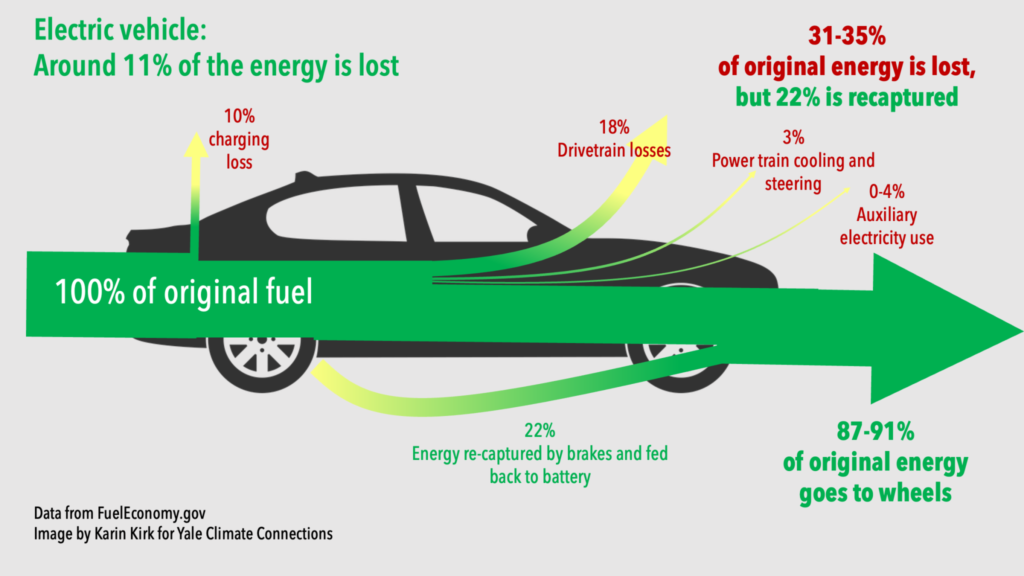
The defining absence—no combustion, no exhaust—reshapes the experience. The U.S. EPA (Environmental Protection Agency) estimates a typical gasoline car emits about 4.6 metric tons of CO2 per year;[5] an EV produces ZERO emissions and significantly less over its life cycle depending on the grid mix.
Many people who drive an EV talk about the ease of driving, the instant acceleration, and the smooth, seamless flow that makes it genuinely pleasant to operate. After such an experience, switching back to a combustion car feels like stepping into a world from the past—almost like an anachronism.
Low Costs and Good Conscience in Everyday Use
Across both the United States and the European Union, the cost of charging an electric vehicle at home is significantly lower than filling up a comparable gasoline car. Modern electric SUVs such as the Volkswagen ID.4, Ford Mustang Mach-E, and Hyundai Ioniq 5 all fall into a similar WLTP (Worldwide Harmonized Light Vehicles Test Procedure) real-world consumption range of 17–22 kWh per 100 km (~60 miles). Over a 500-km (311-mile) trip, for instance, this means they typically use 85–110 kWh of electricity.
In the United States, where the average residential electricity rate is $0.16 per kWh,[6] powering these vehicles for 311 miles costs only $14–18. In Europe, with an average household rate of €0.29 per kWh,[7] the same 500-km distance costs roughly €24–32, depending on the specific model. This grouped comparison shows that mainstream electric SUVs deliver very similar—and consistently low—energy costs across regions.
By contrast, a typical gasoline SUV covering 500 km (311 miles) costs roughly $35–40 in the U.S. at around $3.15 per gallon,[8] and €50–55 in Europe at roughly €1.70 per liter.[9]

Battery prices define sticker prices. Industry tracking shows average pack costs fell from roughly $1,200/kWh in 2010 to $139/kWh in 2024,[10] and to $94/kWh in 2025[11]. This not only helps EV sales, but also supports the deployment of large energy-storage systems (BESS), which store and provide clean energy in a Solarpunk grid.
Beyond numbers, owners consistently report a soothing feeling that mobility no longer relies on drilling, refining, and burning. On top of that, as more people generate their own electricity with rooftop PV solar systems or balcony solar units—and in some cases store it in home battery solutions—an EV can be operated in a decentralized, autonomous way, even off-grid if necessary. And once the initial installation costs of the solar systems are amortized, the effective cost of charging drops even further, in some cases approaching zero.
Solarpunk is oriented toward clean, affordable mobility, so these numbers make a compelling case: electric vehicles are not only cleaner, they are substantially cheaper to operate!

Charging That Fits Real Life
Modern electric SUVs—for instance, the Audi Q6 e-tron, with a range of up to 625 kilometers (388 miles)—can add impressive range in remarkably short time: under ideal conditions, they can gain up to about 255 kilometers (158 miles) of driving range in just ten minutes at a high-power fast-charging station, with peak charging capacities around 270 kW.[12] A typical fast-charge session from 10 to 80 % takes roughly 20 minutes, making long-distance travel both practical and time-efficient: long enough for a grocery run or coffee.
Many supermarkets, discounters, DIYs and retail parking lots now host high-power chargers, turning energy top-ups into ordinary stops and minimizing perceived downtime.
Charging networks are scaling quickly: The EU lists more than a million public charging points,[13] and the U.S. exceeds 200,000 public chargers.[14] With route planners and plug-and-charge payment, charging up becomes part of the day rather than a detour from it.

Pride in Zero Tailpipes
Eliminating both the heat of combustion and all tailpipe emissions removes carbon monoxide, nitrogen oxides, particulate matter, and tailpipe CO₂ from street level—unnecessary heat sources and pollutants linked to millions of premature deaths annually; see also Urban Heat Islands.
EV Sales Figures and Positive Outlook[15]
Global electric car sales (passenger cars and light-duty vehicles) reached 17 million in 2024, over 20% of all new cars. China led the market with more than 11 million EVs sold, making 1 in 10 cars on its roads electric. Europe’s sales leveled off as subsidies declined but still held a 20% share, while the U.S. grew 10% to just over 10% of new cars. Emerging markets in Asia and Latin America expanded quickly, with sales up 60% to nearly 600,000, largely driven by affordable Chinese imports.
In 2025, worldwide EV sales are expected to exceed 20 million, or one-quarter of all new cars. China may reach 60% EV share, Europe about 25%, and the U.S. around 11%, while emerging economies (excluding China) could hit 1 million EV sales.
By 2030, EVs are projected to surpass 40% of global car sales under current policies. China may reach 80%, Europe nearly 60%, and the U.S. around 20%. Southeast Asia is also set for rapid growth, with about a quarter of new cars and a third of two- or three-wheelers becoming electric. By then, EV adoption across all vehicle types could displace more than 5 million barrels of oil per day, with China responsible for half of that reduction.
The data shows a structural shift: EVs are no longer a niche but a growing share of global car fleets. Adoption is uneven—in China nearly one in two cars sold is electric, in Europe it is closer to one in ten, and in much of the world nearer to one in twenty.

EVs in the Solarpunk World: Electric Dreams Come True!
In a Solarpunk future, mobility works with the planet—not against it—and that future has become present day thanks to today’s electric vehicles. They move quietly, efficiently, and without fumes, cut running costs dramatically, and get cleaner as renewable grids and rooftop solar expand.
With fast-growing charging networks, falling battery prices, and accelerating global adoption, EVs are no longer a niche or a compromise but a practical upgrade in comfort and conscience. Solarpunk is about choosing renewal over depletion, and the EV is its clearest everyday expression—a quiet, capable sign that a brighter mobility transformation is already unfolding.
Sources:
[1] https://www.eea.europa.eu/publications/electric-vehicles-from-life-cycle/at_download/, p. 59
[2] https://www.eea.europa.eu/en/analysis/indicators/health-impacts-of-exposure-to-1?utm_source=chatgpt.com
[3] https://www.caranddriver.com/features/g40971175/fastest-electric-cars/
[4] https://yaleclimateconnections.org/2024/01/electric-vehicles-use-half-the-energy-of-gas-powered-vehicles/
[4] https://evreporter.com/understanding-the-complete-efficiency-picture-of-electric-vehicles/
[5] https://www.epa.gov/greenvehicles/greenhouse-gas-emissions-typical-passenger-vehicle
[6] https://www.electricchoice.com/electricity-prices-by-state/
[7] https://ec.europa.eu/eurostat/statistics-explained/index.php?title=Electricity_price_statistics
[8] https://www.nrdc.org/stories/electric-vs-gas-cars-it-cheaper-drive-ev
[9] https://www.transportenvironment.org/articles/electric-cars-are-still-cheaper-to-run-than-petrol-and-diesel-te-did-the-maths
[10] https://about.bnef.com/insights/clean-energy/lithium-ion-battery-pack-prices-hit-record-low-of-139-kwh/
[11] https://evcurvefuturist.com/2025/10/lithium-ignites-the-shock-that-will-rewrite-the-energy-market/
[12] https://www.audi-mediacenter.com/en/the-audi-q6-e-tron-electric-mobility-on-a-new-level-15929/battery-and-charging-15933
[13] https://alternative-fuels-observatory.ec.europa.eu/transport-mode/road/european-union-eu27/infrastructure?
[14] https://theicct.org/publication/us-charging-infrastructure-deployment-through-2024-apr25/
[15] https://www.iea.org/reports/global-ev-outlook-2025