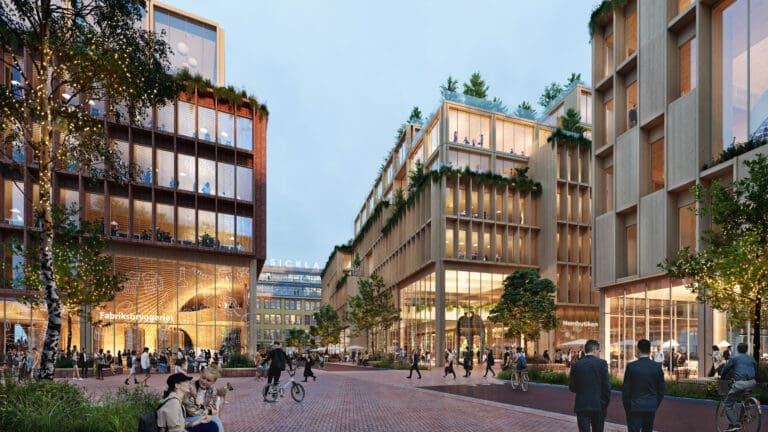
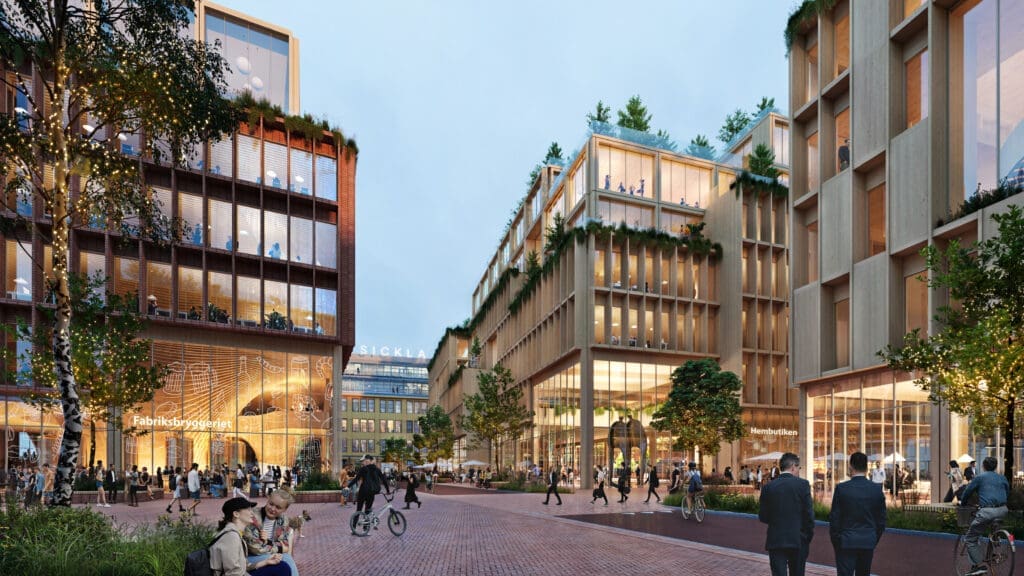
Stockholm Wood City is one of the most concrete and instructive future-city projects underway today. Rather than proposing a new city from scratch, it embeds climate ambition inside an existing metropolitan fabric and does so with tools that already exist. The project positions mass timber construction, mixed-use density, and innovative energy thinking as practical levers for urban transition. For anyone interested in Solarpunk as a grounded, buildable urban future, Stockholm Wood City offers the combination of vision and delivery.
Context
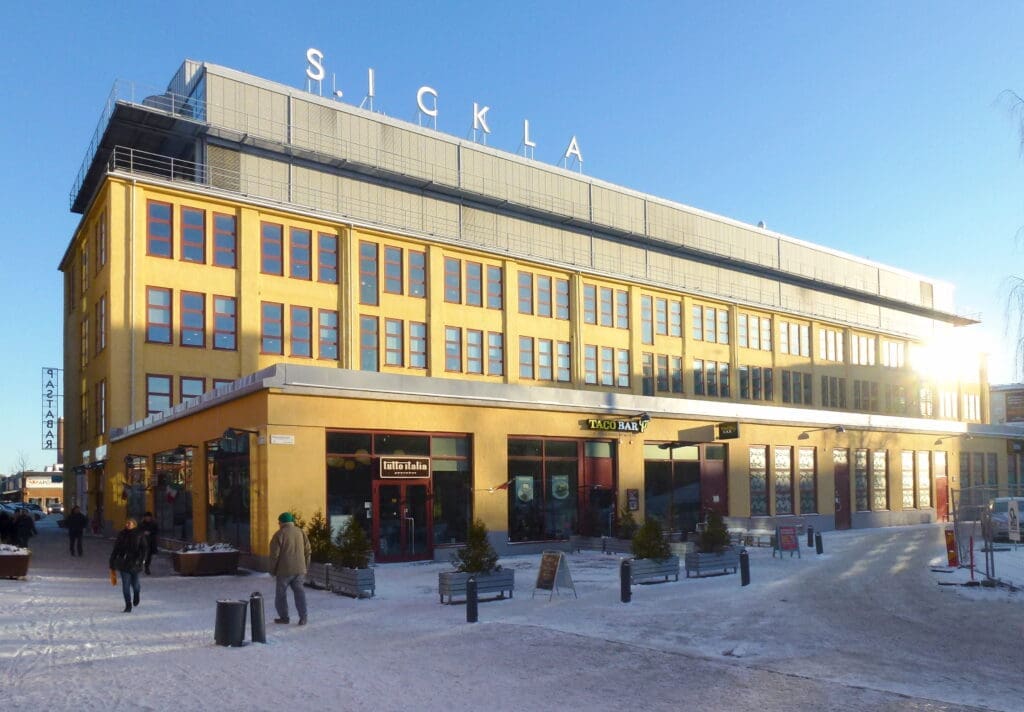
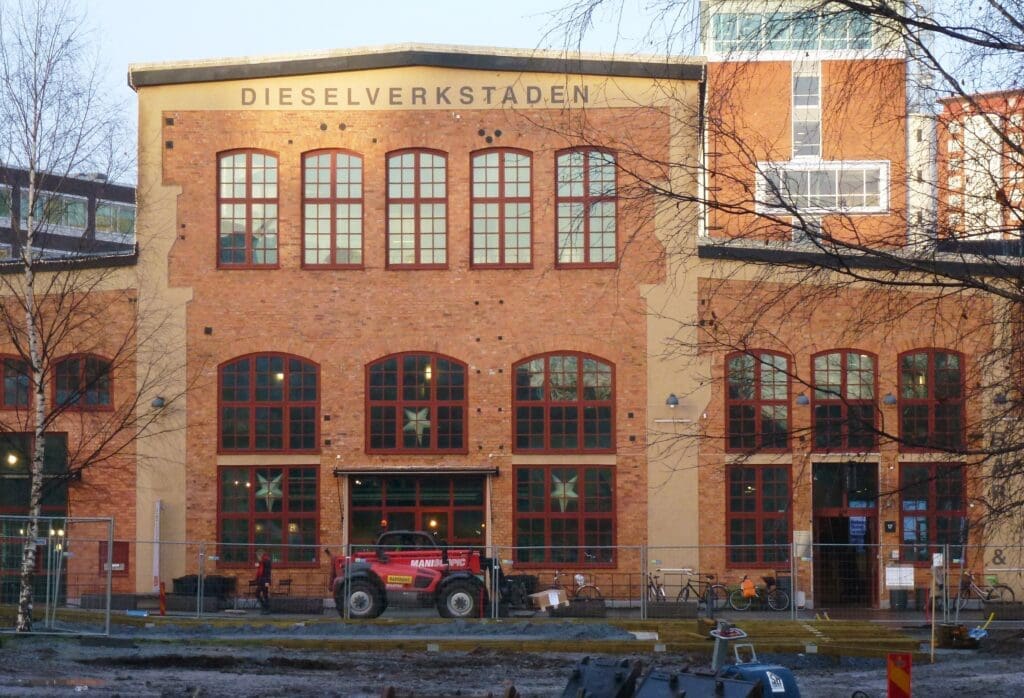
The project is located in Sickla, a former industrial area southeast of central Stockholm that has been gradually redeveloping over the last two decades.[1] Instead of expanding outward into greenfield land, the development focuses on urban infill and reuse of existing infrastructure. This context matters. Stockholm Wood City is not an isolated eco-enclave but an extension of a working city with transit connections, employment centers, and everyday life already in motion.
Motivation and Goals
Stockholm Wood City is driven by a strong sustainability vision and the need to reduce the climate impact of urban construction. By using timber as the primary material, the development aims to significantly lower CO2 emissions throughout construction and the buildings’ life cycle, while also enabling faster, quieter building processes and promoting healthier indoor environments.[2] At the same time, the project addresses a regional planning need by increasing workplace capacity in southern Stockholm, responding to the deficit of jobs south of the inner city and aiming to shorten commuting times, while integrating self-sustaining energy solutions aligned with national goals.[3]
The project’s overarching goal is to set a global benchmark for large-scale timber urban development. Rather than competing for the tallest wooden skyscraper, Stockholm Wood City seeks to become the world’s largest wooden-built urban area, integrating offices, housing, and retail across 25 blocks and 250,000 square meters.[3] In doing so, it aims to demonstrate that climate-conscious construction can function at the scale of an entire city district and serve as a model for sustainable urban development worldwide.
At full build-out, the district is expected to include 7,000 office spaces, 2,000 homes as well as a variety of retailers and restaurants.[3] It is planned as a mixed-use neighborhood rather than a single-purpose development. This urban normalcy is one of its strengths. The project is not asking residents to adopt an experimental lifestyle, only to live in buildings and streets designed with lower carbon and higher environmental quality.
Material Strategy
The defining feature of Stockholm Wood City is its large-scale use of fireproofed mass timber as a primary structural material. Buildings are designed using engineered wood products such as cross-laminated timber and glulam (glued laminated timber),[4] replacing conventional concrete and steel where possible. This approach directly addresses embodied carbon, which accounts for a growing share of emissions in energy-efficient buildings.
Wood stores carbon absorbed during tree growth and generally requires less energy to process than mineral-based materials. When sourced from sustainably managed forests, it can significantly reduce the climate footprint of construction. Sweden’s forestry sector and regulatory framework make this approach especially viable, but the lessons extend beyond national borders.
The use of timber also changes the sensory experience of the city. Interior spaces with exposed wood tend to feel warmer and less industrial, reduces stress, and the construction process itself can be faster and quieter. These qualities are often overlooked but matter for everyday urban life.
Urban Form and Density
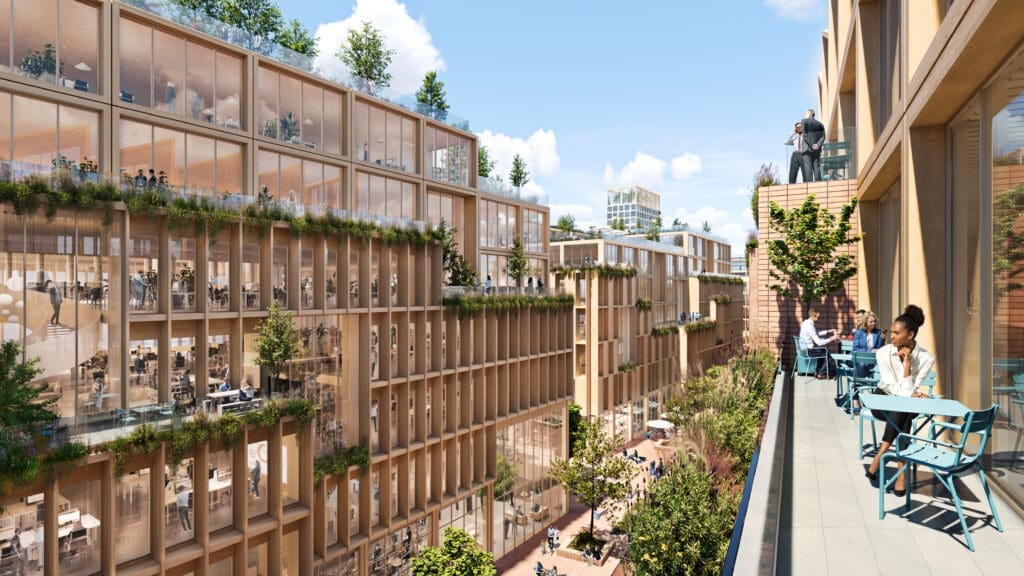
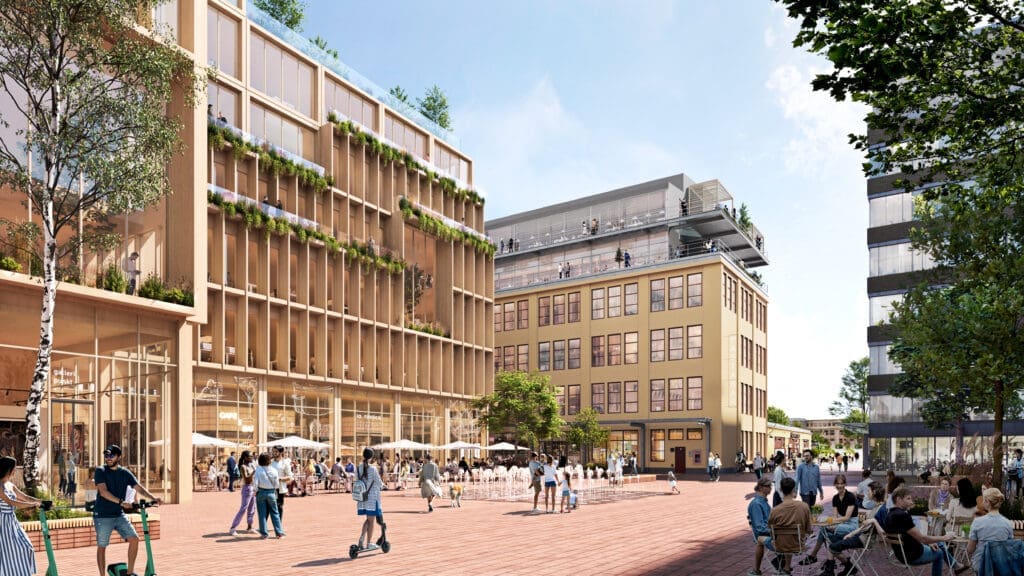
Stockholm Wood City does not rely on extreme height or iconic forms. Instead, it follows a mid-rise, compact urban pattern that balances density with human scale. Streets are designed to prioritize walking and cycling, with active ground floors and short block lengths. Public spaces are distributed throughout the district rather than concentrated in a single park.
Density here is treated as an environmental asset. By concentrating housing and workplaces near transit, the project reduces car dependency and supports local services. This aligns with Solarpunk ideals that emphasize proximity, everyday accessibility, and social interaction over sprawling, energy-intensive development.
Energy and Systems
Climate impact is reduced through a system of locally produced, stored, and shared energy. Extensive rooftop solar installations are combined with advanced storage solutions, including underground geothermic reservoirs and bedrock facilities that store electricity, heating, and cooling, positioning Sickla at the forefront of energy innovation.[4]
The emphasis is on efficiency and sharing rather than full self-sufficiency. Buildings are designed to high energy-performance standards, reducing demand before adding new supply. Water management, waste handling, and logistics are also integrated at the district level. These elements are less visible than architecture but critical for reducing resource use and operational emissions over time.
Governance and Development Model
Stockholm Wood City is led by a private developer working within Sweden’s planning framework. This means the project operates under existing regulations, building codes, and democratic planning processes. While this limits some experimentation, it increases the likelihood that solutions can be replicated elsewhere.
By working within mainstream development structures, the project demonstrates how incremental yet meaningful change can occur at scale. This makes it especially valuable as a case study for cities that want to decarbonize without reinventing their entire governance system.
Social and Environmental Quality
Beyond carbon metrics, Stockholm Wood City emphasizes quality of life. Access to daylight, greenery, and public space is treated as a core design parameter. Its nature-informed design also includes green roofs and large windows to maximize natural light and create an environment that reflects harmony with nature.[5]
Conclusion
Stockholm Wood City represents a form of Solarpunk realism. It shows how existing cities can change direction using tools already available. Mass timber, geothermal and solar energy, compact urban form, and mixed-use development are not speculative — they are being applied today.
From a Solarpunk perspective, this is what makes the project compelling. The transition to greener cities depends less on technological breakthroughs than on the disciplined application of known principles at scale. Stockholm Wood City treats sustainability as an urban design challenge, not a branding exercise.
Already under construction and embedded in everyday urban life, it demonstrates that a sustainable future city can be built gradually, block by block, through wooden materials, density, and shared infrastructure.
Sources:
[1] https://en.wikipedia.org/wiki/Sickla_K%C3%B6pkvarter
[2] https://en.wikipedia.org/wiki/Stockholm_Wood_City
[3] https://henninglarsen.com/projects/wood-city-stockholm
[4] https://whitearkitekter.com/news/stockholm-wood-city-a-groundbreaking-project/
[5] https://www.weforum.org/stories/2023/07/sweden-stockholm-wood-city/